- FASHION LABEL DESIGN
- ABOUT US
-
- Creative Product Accessories: Big Ideas in Small Details
- Customized Garment Accessories
- Every Stitch Holds Meaning: The “FLD” Embroidered Logo on the Trench Coat Reflects the Designer’s Altruistic Intent
- The Language of Materials: Notes from a Small-Scale Exploration of Garment Trims
- How the 3D LenticularPatch Factory Became the “Three-Dimensional Magician” Behind Leading Brands
- Lighting the Path of Fashion: Innovative Application of PVC Luminous Patches in Garment Accessories
- The Story Behind Silicone Patches: Craftsmanship and Color Magic from a Chinese Factory
- CONTACT US
- 2025 NEW SEASON INSPIRATION
The Language of Materials: Notes from a Small-Scale Exploration of Garment Trims
During our recent product development work, we’ve come to a deeper realization: garment trims are far more than just signature attachments—they are an indispensable part of the visual and emotional language of clothing. Trims can enhance a design’s storytelling, deepen the tactile memory of the user, and even silently express the wearer’s taste and attitude.
We regularly compile small sample sets of garment accessories. Sometimes they’re just early-stage experiments, but the process itself often leads to valuable insights worth recording. This article shares some of our recent explorations in material selection, shape design, and craft combinations—hoping they might offer inspiration or perspective for others also on a creative path.
1. Leather Meets Metal: Reconstructing a Visual Language of “Protection”
Our first experiment centered on a bold, intuitive combination: leather + metal studs.
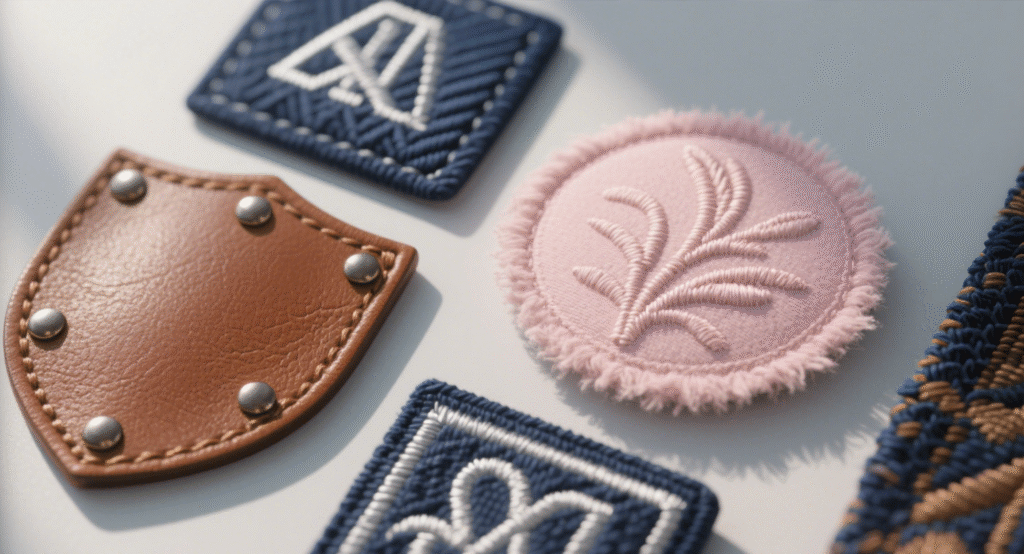
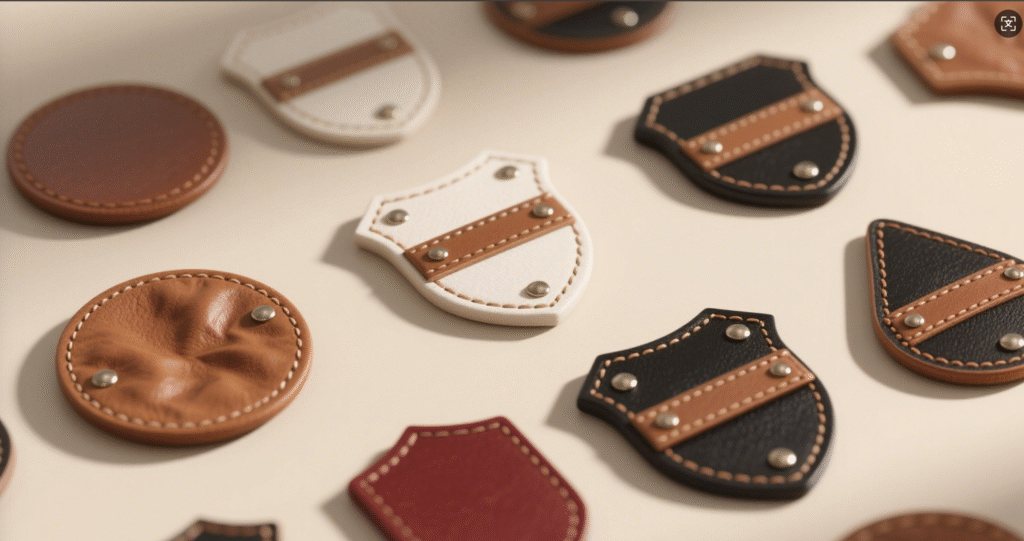
Leather naturally carries a sense of tension and warmth, especially when it has the right balance of thickness and texture. It conveys stability and a classic aesthetic. When we added small metal studs to the surface, the piece immediately gained a stronger sense of craftsmanship. The result not only enhanced the structural feel but also evoked a subtle visual cue of protection or defense—like a shield safeguarding something valuable beneath.
This combination eventually became a shield-shaped sample patch. It contains no text, but it has a quiet, assertive presence. We believe this style might suit product lines that emphasize functionality and strength—such as techwear, outdoor apparel, or cycling gear.
2. Lines That Grow: Exploring Botanical Language Through Embroidery
To contrast the heaviness of leather, we wanted to bring in some softer, more “breathable” elements through trims.
So we explored embroidering plant motifs, a direction highly sensitive to the expression of life and nature.
In the design process, we tested various thread weights and embroidery techniques—chain stitch, satin stitch, 3D embroidery, and more—to observe how each affected texture and visual feedback on the fabric. One of the results was a pink circular patch featuring an abstract plant motif in the center and frayed edges around the perimeter.
From this sample, we drew two key insights:
Embroidery is not just a way to express a pattern—it is a texture language in itself. The direction, density, and finish of each thread line contributes to the overall mood.
Botanical themes are highly versatile. They can be gentle or wild, decorative or narrative-driven.
We hope to further this direction by incorporating more natural elements like flowers, vines, and leaves—or even exploring sustainable embroidery threads—to create a deeper connection between nature and material storytelling.
3. Imperfect Edges That Give Life to a Design
We’ve noticed that the most emotionally resonant design details are often not those with perfect, uniform edges, but rather those with controlled irregularities. This became one of the focal points in our recent experimentation.
On the edge of the pink botanical patch, we intentionally implemented a frayed finish. This wasn’t an accidental leftover—it was a tested approach to create soft edges through controlled unraveling. Visually, it softened the outline; emotionally, it introduced a subtle sense of growth and transformation, as if the fibers were alive and evolving over time.
This kind of detail often evokes emotional resonance—reminiscent of mended patches on childhood clothes or the wear and tear of well-loved fabric goods. Sometimes, imperfection is the very thing that allows us to connect emotionally with an object.
4. Failed Experiments Are Also Invisible Steps Forward
Of course, not all experiments worked perfectly.
Some embroidery motifs ended up too intricate in scale and lost visual clarity in production. Some materials looked great when static, but proved unstable or wrinkled too easily in motion.
Yet we kept nearly all the samples—not just the “good” ones, but also the not-quite-there results.
We believe that the existence of failed samples is itself a form of knowledge accumulation. They help define boundaries and constraints, leading to more precise judgments in the future. Especially when working with mixed materials, the lessons from failures can often be more revealing than those from success.
5. Rethinking the “Language of Trims”
This entire sampling and testing process led us to rethink what we mean by the language of trims.
In the past, we may have treated trims as mere “decorations” or afterthoughts added at the end of the design process. But now we increasingly feel that they deserve to be a subject in their own right—not just materials, but emotional vessels, carriers of memory, and elements of cultural expression.
They are the gentle reminder on the edge of your sleeve, the bold statement tucked into the corner of a bag, the unspoken message embedded in a garment’s brand story. They don’t speak, yet they are felt.
6. In Closing: An Open Invitation to Share and Exchange
Perhaps these small trials might offer a fresh perspective for a question you’ve been thinking about.
If you’re also working on material, process, or accessory-related design, we’d love to hear about your experiments. We welcome comments or private messages. After all, in design, many of the most valuable insights don’t come from the final product—but from the exchange of processes.
Let’s enrich the language of clothing together—one thoughtful detail at a time.